How AI Improves Lead Scoring Accuracy?
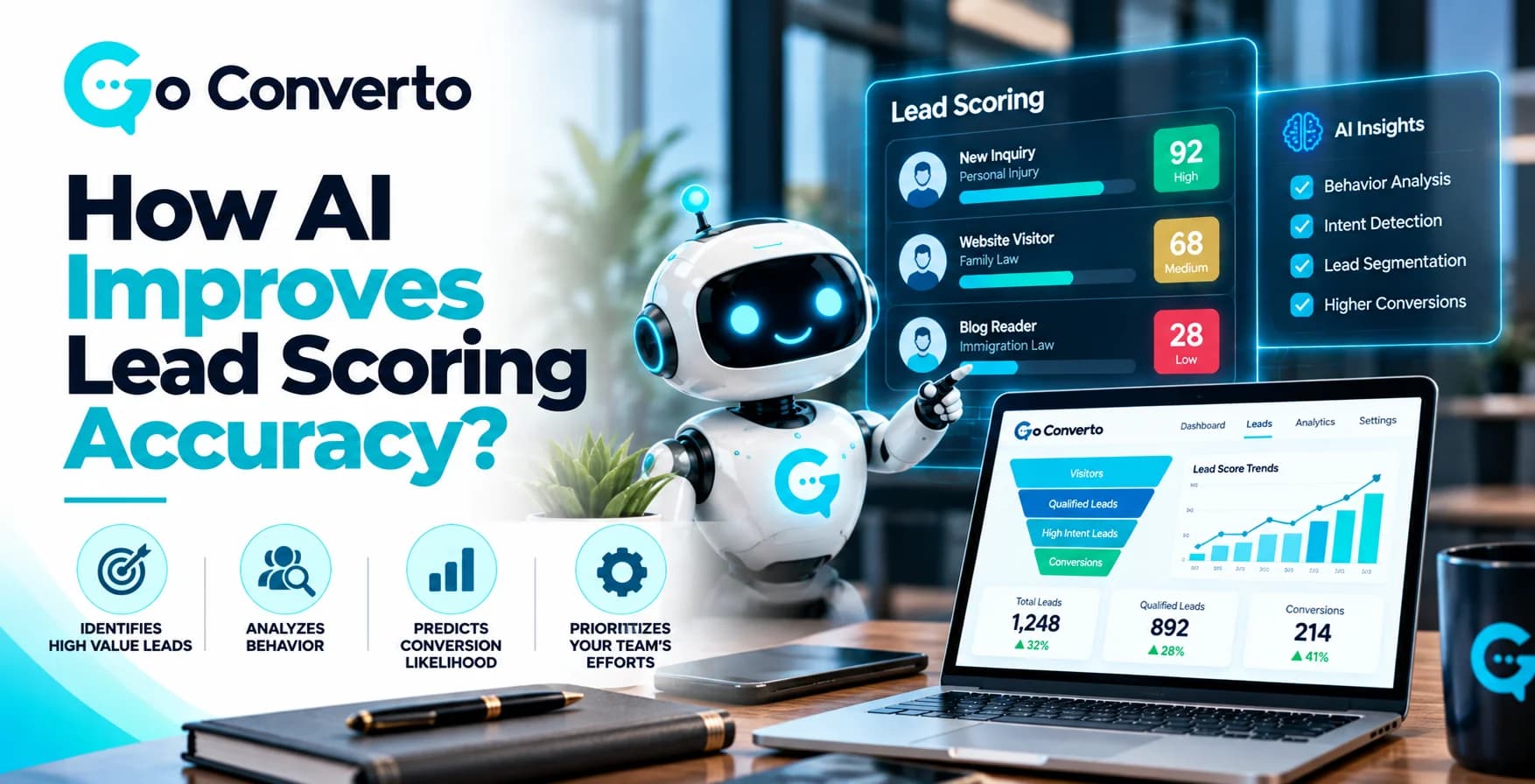
Caption: Learn how AI-powered lead scoring helps your sales team prioritize high-intent prospects faster.
Description: Discover how artificial intelligence improves lead scoring accuracy by analyzing user behavior, identifying high-value prospects, and boosting sales conversions.
Artificial intelligence uses machine learning models in place of fixed point values to increase lead scoring accuracy. It studies thousands of closed deals, then rank new leads on conversion pattern. Traditional manual scoring hits 15 to 25% accuracy. AI models trained on historical outcomes reach 40 to 60%, cutting wasted sales hours.
KEY TAKEAWAYS
- AI lead scoring elevates prediction accuracy from the 15 to 25% range of manual models to 40 to 60%.
- Companies using AI-driven scoring report roughly 38% higher lead-to-opportunity conversion.
- Fixed-value scoring breaks the moment your product, pricing, or target audience changes.
- Leads contacted within five minutes convert at a far higher rate than leads reached after 30 minutes, and AI chat tools like Go Converto respond in about two seconds.
- The biggest accuracy gains come from combining behavioral, firmographic, and conversational data, not from any single signal.
What Is AI Lead Scoring and Why Does Accuracy Matter?
AI lead scoring is the practice of using machine learning models, instead of a spreadsheet of fixed point values, to rank how likely a lead is to become a paying customer. The model studies your historical wins and losses, finds the patterns a human would never spot across thousands of records, and assigns every new lead a live probability score.
Accuracy is the whole point here. A wrong score does not just waste a little time. It sends a rep chasing a lead that was never going to close while a genuinely ready buyer sits untouched in the queue. Our surveys show this pattern shows up constantly in small Florida service businesses. Owners assume more leads means more sales, when really they just need better sorting.
Independent research backs this up too. Gartner's analysis of AI in sales points to conversational intelligence as one of the fastest growing inputs into lead scoring models, precisely because it captures buyer intent that a static form never could.
The market backs this up. Predictive lead scoring adoption has grown fast, and Salesforce's State of Sales 2026 report found that 87 percent of sales organizations now use some form of AI for prospecting, forecasting, or lead scoring, with 94 percent of leaders already running AI agents calling them critical to hitting their targets.
Aggregated performance metrics based on Salesforce State of Sales and Gartner sales intelligence research.
How AI Actually Raises Lead Scoring Accuracy
Traditional scoring assigns arbitrary points. A pricing page visit gets 15 points, a demo request gets 50, and nobody revisits those numbers once they're set. AI scoring skips the guesswork entirely. It trains directly on what has actually predicted a closed deal in your own CRM, then keeps adjusting as fresh outcomes roll in.
Three things drive the accuracy jump. First, the model reads behavioral signals in real time instead of on a weekly export. Second, it weighs firmographic fit (company size, industry, budget signals) against actual buying behavior rather than treating them as separate checklists. Third, it decays stale signals automatically, so a content download from eight months ago stops carrying the same weight as a pricing page visit from this morning.
The Continuous AI Lead Scoring Cycle
How dynamic machine learning models process, score, and reweight buyer intent
Step 1 — Data Collection
The model pulls behavioral, firmographic, and conversational data from your site, CRM, and chatbot transcripts.
Step 2 — Pattern Training
It studies which combinations of signals actually led to closed-won deals in your own historical data.
Step 3 — Live Scoring
Every new visitor or lead gets scored the moment they engage, not after a manual review cycle.
Step 4 — Continuous Reweighting
As new deals close or fall through, the model updates its weighting automatically, so the score stays current.
“Lead scoring models that stay static get worse every quarter, not better. The market shifts, your offer shifts, and a score built on last year's buyers stops meaning much. Machine learning fixes that because it never stops relearning.”
Traditional Scoring vs. AI Scoring (The Real Difference)
Put the two models side by side and the gap stops being theoretical. Traditional scoring is a static rulebook. AI scoring is a living model that gets sharper with every closed deal.
| Traditional Rule-Based Scoring | AI-Driven Scoring |
|---|---|
| Fixed point values set once, rarely revisited | Weights learned from actual closed-won and closed-lost outcomes |
| 15 to 25 percent prediction accuracy | 40 to 60 percent prediction accuracy |
| Treats every visit the same regardless of timing | Decays stale signals and prioritizes fresh intent |
| Requires manual rule updates after every offer change | Reweights automatically as new data arrives |
| Scores sit in a dashboard, waiting for a rep to check | Scores can trigger instant chat, routing, or booking |
Side-by-side architectural comparison of rule-based vs. dynamic machine learning scoring systems.
See What Go Converto Learns From Your Site in Minutes
Paste your URL. Watch it scan your services, pricing, and FAQs automatically to qualify high-intent buyers 24/7.
What Signals Matter Most for Accurate AI Lead Scoring
Not every data point pulls its weight. Some signals barely move the needle. Others predict a close almost on their own.
What a lead actually asks a chatbot or sales rep, which is a far stronger signal than a passive page view.
A lead contacted within five minutes is roughly 21 times more likely to qualify than one reached after 30 minutes.
Company size, location, and industry, weighed against your actual customer base rather than a generic ideal customer profile.
Chat transcripts, emails, and call notes, which a Forrester report on AI-enhanced lead scoring found add roughly 43 percent higher prediction accuracy over structured data alone.
This is exactly where a chat-first tool has an edge over a form-only funnel. Go Converto's how it works page shows the model in practice. The assistant scans a business site, learns the services and FAQs, then asks visitors thoughtful follow-up questions instead of relying on a static form nobody wants to fill out.
Where Accuracy Gains Actually Come From
Cumulative prediction accuracy lift as additional signal layers are integrated
What Changes When Scoring Gets Accurate
Florida service businesses running form-only lead capture tend to describe the same frustration. Leads trickle in, someone eventually calls back, and half the conversations go nowhere. Fixing the scoring model changes the day-to-day, not just the dashboard.
- Reps guess which leads to call first based on gut feel
- 79 percent of marketing leads never convert to sales
- Average lead response time runs around 42 hours
- Only about 27 percent of leads sent to sales are actually ready
- Leads arrive pre-qualified with a live conversion probability
- Sales-ready leads surface within seconds of a site visit
- Chat response time drops to roughly two seconds, day or night
- Reps spend their limited selling hours on leads worth chasing
“The moment someone is reading your pricing page is the moment that matters most. A chatbot meets them right there, before the tab gets closed, and that timing signal alone changes which leads are actually worth a rep's time.”
How Can a Small Florida Business Implement AI Lead Scoring?
You do not need a data science team to get most of the benefit here. The businesses seeing the fastest gains are usually the smallest ones, mainly because they had no scoring system at all before.
Most teams can be live within a day. Go Converto's pricing page shows the setup takes minutes once a website URL is entered, with no developer required.
- 1Start with conversational capture instead of a static form. A chatbot that asks qualifying questions in real time replaces manual scoring rules almost entirely.
- 2Feed the model your own closed-deal history early. Even a few months of clean CRM data sharpens accuracy fast.
- 3Route high-probability leads instantly rather than batching them. Daily reports gather dust while leads go cold; instant routing strikes when intent is peaked.
- 4Revisit the model quarterly. Even AI-driven scoring drifts if your offer, pricing, or ideal customer shifts and nobody checks in.
This is the gap most local businesses fall into. They install analytics, maybe a chat widget, and call it done. But a widget that only answers FAQs is not scoring anyone. Go Converto's blog on capturing leads around the clock walks through the no-code side of this, and it pairs directly with the scoring logic covered here.
For a deeper technical look at how machine learning models weigh signals, Gartner's research on sales technology adoption is a solid independent starting point, and it lines up closely with what we see in practice.
The Bottom Line for Florida Businesses
Accuracy is the difference between a sales team that spends its day chasing dead ends and one that spends it closing. Go Converto was built around this exact gap. It scans a business site in minutes, learns the services and pricing, then talks to every visitor like a team member who already knows the answers, qualifying leads with real conversation instead of a form nobody finishes.
Businesses already running Go Converto, from law firms to healthcare practices, see the same pattern. More of the right conversations happen, and fewer good leads slip through simply because nobody called back in time.
See Your Website Learn Your Business in Minutes
No coding, no forms to build. Paste your URL and Go Converto starts qualifying leads today.
Frequently Asked Questions
Ready to Stop Losing Visitors? Let’s Live Your ChatBot
Ask us anything about plans, setup, or your specific business. We reply within one business day.
Start Your Free Trial