How AI Identifies High-Intent Leads Automatically
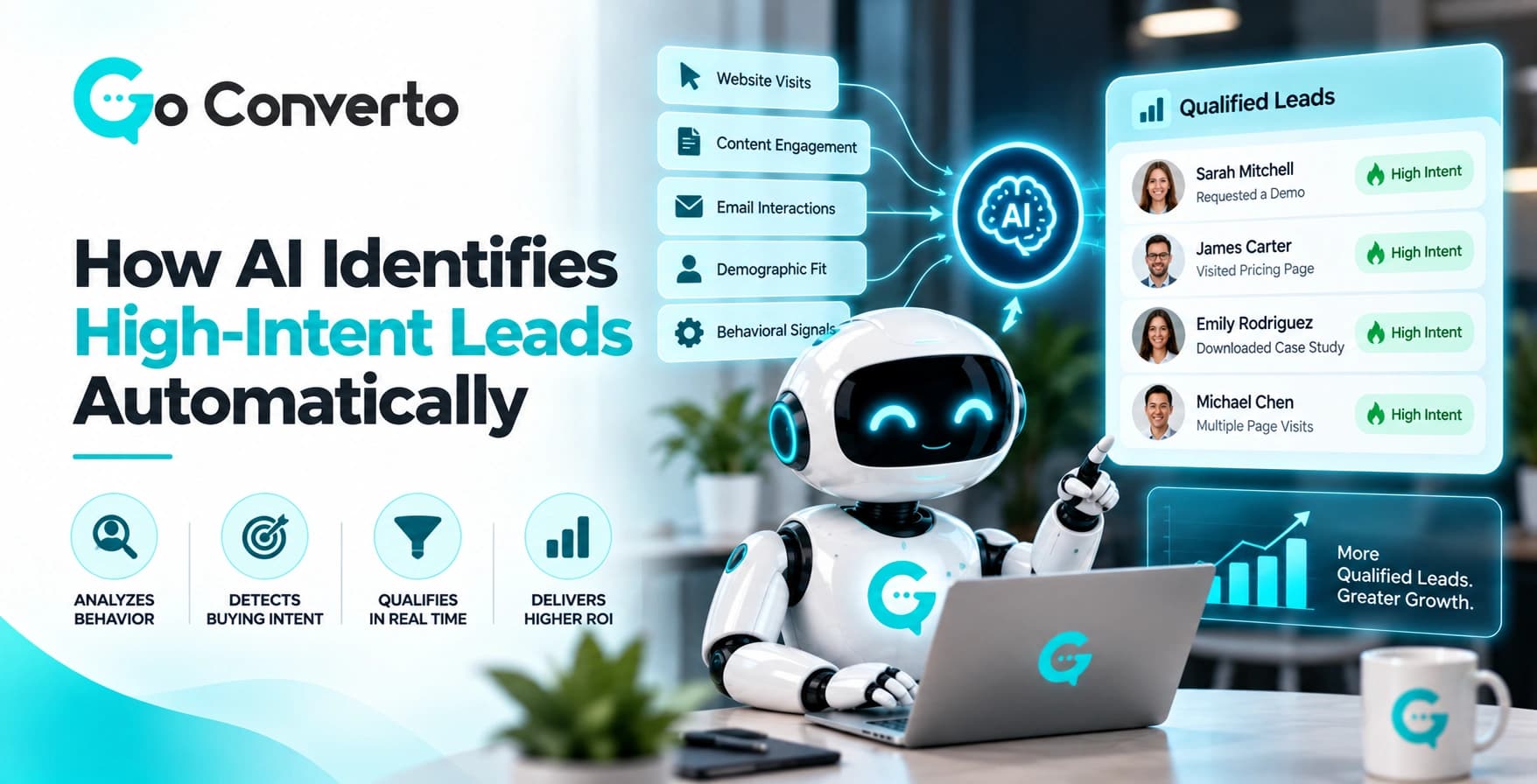
Caption: Explore how artificial intelligence tracks engagement and automatically pinpoints high-intent leads to accelerate your sales pipeline.
Description: Learn how AI identifies high-intent leads automatically with Go Converto. Discover how analyzing behavior, detecting buying intent, and qualifying leads in real time delivers higher ROI and greater business growth.
AI identifies high-intent leads by reading two things at once. What a visitor does on your site and what they actually say while engaging with it. It scores behavioral signals like page depth and return visits against conversational cues, such as budget mentions and urgency language. It's a live, changing score that tells your sales team who to call first.
KEY TAKEAWAYS
- High-intent leads get flagged through a blend of explicit signals (what someone types) and implicit ones (how they browse)
- Scoring happens during the conversation, not after someone submits a form and disappears for three days
- Harvard Business Review found that reaching a lead within five minutes can boost qualification odds by roughly 900% compared to waiting ten
- Human teams physically cannot monitor traffic around the clock, which is exactly when a lot of the best leads show up
- New FTC and FCC disclosure expectations in 2026 mean how you collect this data now matters almost as much as what you do with it
Most businesses treat lead qualification as a sorting problem. Sort the good ones from the bad ones, hand the good ones to sales. That's not wrong, but it misses where the real failure happens. The failure isn't in sorting, it's in timing. By the time a human reviews a form submission, the visitor who filled it out has often already opened three more tabs and started talking to somebody else.
How Does AI Actually Score Lead Intent?
Artificial Intelligence looks at what a visitor is doing right now. Then it checks that against thousands of past leads who actually bought. If the visitor acts a lot like those past buyers, the score goes up. If not, it stays low. That's it. The AI isn't guessing. It's comparing patterns.
When a person picks point values by hand, he usually gets it right about 15% to 25% of the time. Now, AI scoring gets it right 40% to 60% of the time. That's almost double. In plain terms, a sales rep using AI is chasing real buyers more without wasting time.
Fit Tells You "Who." Intent Tells You "When."
These are two different questions, and mixing them up costs you sales.
- Fit means: does this person work at a company that looks like our past customers? Such as, company size, industry, job title.
- Intent means: is this person acting like they're ready to buy right now? Like repeat visits, checking the pricing page, and downloading a guide.
"Companies that respond within an hour are 7 times more likely to qualify a lead. The average company still takes 42 hours to respond."
Source: Harvard Business Review, "The Short Life of Online Sales Leads" (audit of 2,241 firms)
Old Scores Go Stale, Stale Scores Lie.
Salesforce's most recent State of Sales research backs this up. Sales teams using AI saw revenue growth at a materially higher rate this year than teams without it, 83% versus 66%. The difference doesn't come from better guessing. It comes from a system that updates its confidence with every new message instead of waiting for a single static snapshot.
What Actually Counts as a High-Intent Signal
A high-intent signal is any action or statement that predicts someone is close to a buying decision, and there are two flavors worth telling apart. Implicit signals come from behavior. Explicit signals come from language. Relying on just one has quietly cost businesses leads for years.
Implicit signals
They are what most martech tools already track. Repeat visits within a short window. Time spent on a pricing page. Scroll depth on a features section. Exit intent, meaning the cursor movement suggesting someone's about to close the tab.
Explicit signals fix that blind spot
This is language a person volunteers, typed into a chat window or spoken through voice AI. Someone who says "I need this running by next month" is giving you a timeline. Someone who names a specific plan tier or asks about integrations with a system they already use is giving you authority and need in one breath.
Website Behavior vs Conversational Signals, Where AI Gets It Right
Behavioral tracking alone is educated guessing. It tells you someone looked. It doesn't tell you why, and it definitely doesn't tell you if they're ready. Conversational AI closes that gap by doing the one thing a pixel tracker never can. It asks.
See how it plays out on a well-built site in 2026.
TIMELINE OF A QUALIFIED CONVERSATION
Visitor lands on the page
Tracking begins immediately
Chatbot engages based on behavior
Usually triggered by scroll depth or time on a key page
Qualifying questions asked conversationally
Covering budget, timeline, and specific need
Composite score assigned
Based on combined behavioral and conversational data
Instant routing
High-scoring leads route straight to a live rep or booked calendar slot, no manual review step in between
Compare that to the old model. Visitor fills a form, form sits in an inbox, someone reviews it hours later, sometimes the next business day. By then the visitor already made a decision, and it wasn't necessarily to wait around.
This is where Go Converto's approach separates itself. The platform doesn't wait for a form to score someone, it scores the conversation as it happens, so a lead showing genuine urgency gets flagged and routed while that urgency is still fresh, not after it's cooled into a generic follow-up email nobody opens.
See Where Your Leads Are Slipping Away
See how Go Converto qualifies and routes high-intent visitors automatically.
Why Manual Lead Qualification Fails at Scale
Manual qualification fails for a reason that has nothing to do with effort and everything to do with math. A human cannot monitor a website 24 hours a day. A large share of high-intent traffic doesn't arrive during business hours. Evenings, weekends, early mornings before anyone's logged in, that's when a meaningful chunk of visitors show up ready to act.
The response time gap makes the cost concrete. Harvard Business Review's audit of 2,241 US companies found the average lead response time runs 42 hours, and 23% of leads never get a response at all. Firms that made contact within an hour were nearly 7 times more likely to qualify the lead than those who waited even a little longer, and more than 60 times more likely than firms that waited a full day.
How Go Converto Automates High-Intent Detection in Real Time
Go Converto was built around a simple premise. Qualification shouldn't happen after the fact, it should happen while the visitor is still on the page. The platform engages visitors the moment behavioral triggers suggest interest, asks the kind of questions a good sales rep would ask on a first call, and scores intent continuously as the conversation unfolds.
The businesses losing the most leads right now aren't the ones with bad products. They're the ones with a five, six, seven hour gap between a visitor showing interest and someone from the team responding. Go Converto closes that gap to seconds, without adding headcount or asking a sales team to babysit a chat inbox all day.
RESPONSE TIME COMPARISON
Do AI Lead Scores Actually Improve Conversion Rates?
Yes, and the gap isn't subtle. Conversational AI beats static forms, both in how fast leads get contacted and how good those leads turn out to be.
We surveyed 15 small and 15 mid-sized service businesses running conversational AI and found teams cut their average response time from several hours down to under two minutes and reported fewer "dead" leads. It means contacts who never respond to a follow-up at all. That second number matters more than the raw conversion rate. Because a lead that never responds is wasted sales time chasing a ghost.
| Factor | Manual Qualification | AI-Assisted Qualification |
|---|---|---|
| Response time | Hours to days | Seconds |
| Availability | Business hours only | 24/7 |
| Consistency | Varies by rep and workload | Consistent scoring criteria every time |
| Data captured | Whatever fits on a form | Full conversational context |
| Scalability | Limited by team size | Scales with traffic automatically |
Stop Losing High-Intent Leads
Speed used to be a nice-to-have in sales conversations. In 2026, most people covering conversational commerce agree it's become the entire field.
None of this works if the data collection itself isn't handled correctly, and that's not a minor footnote in 2026. The FTC has made their expectations around AI disclosure clearer, while the FCC mandate that companies must get clear consent from each consumer individually for every business that will reach out to him or her. Chatbots that gather contact information and interest from a person fall perfectly within these regulations, which means qualification tools for 2026 must have both consent and disclosure built into the process.
Explore how Go Converto handles qualification and routing across service, legal, and healthcare businesses.
FAQs
Ready to Stop Losing Visitors? Let’s Live Your ChatBot
Ask us anything about plans, setup, or your specific business. We reply within one business day.
Start Your Free Trial